dlm-js
dlm-js — TypeScript Kalman filter/smoother with autodiff MLE
API Reference | GitHub | Original MATLAB DLM Docs | Original MATLAB DLM GitHubA TypeScript Kalman filter + RTS smoother library using jax-js-nonconsuming, inspired by dynamic linear model (MATLAB). Extends the original with autodiff-based MLE via jit(valueAndGrad + Adam) and an exact O(log N) parallel filter+smoother via lax.associativeScan (Särkkä & García-Fernández 2020).
🤖 AI generated code & documentation with gentle human supervision.
Features at a glance
- Kalman filter & RTS smoother: Sequential (
scan), exact O(log N) parallel (assoc), and square-root parallel (sqrt-assoc) algorithms. - Autodiff MLE & MAP: Jointly estimate observation noise, process noise, and AR coefficients via
jit(valueAndGrad + Adam). MAP estimation withdlmPrior(Inverse-Gamma / Normal priors) or custom loss callbacks. - Multiple backends: Runs on CPU, WASM (recommended for speed), and WebGPU.
- Multivariate observations: Vector-valued observations (p > 1) with full matrix algebra (inv, matmul, einsum, slogdet).
- Missing data & irregular timestamps: Built-in support for NaN observations and arbitrary time steps.
- Forecasting: Propagate states
steps ahead with calibrated uncertainty bounds. - Cross-platform: Works in Node.js and the browser (ESM & CommonJS).
⚠️ Warning: The API is not yet frozen and may change before the 1.0 release.
Installation
dlm-js is not yet published to npm. Install directly from GitHub:
# npm
npm install github:hamk-uas/dlm-js
# pnpm
pnpm add github:hamk-uas/dlm-js
This also installs the @hamk-uas/jax-js-nonconsuming dependency automatically.
Usage
dlm-js works in both Node.js and the browser — the library has no platform-specific code. It ships ESM, CommonJS, and TypeScript declarations.
Naming convention: exported JS/TS APIs use camelCase (for example dlmFit, dlmGenSys), while original MATLAB functions are lowercase (for example dlmfit, dlmsmo, dlmgensys).
If you are migrating older dlm-js code or comparing against MATLAB DLM output, see MIGRATION.md. The current API exposes JS-idiomatic result shapes by default, and toMatlab() / toMatlabMle() restore the MATLAB-style field names and layouts when needed.
ESM (Node.js / browser bundler)
import { dlmFit, dlmGenSys } from "dlm-js";
// Nile river annual flow data (excerpt)
const y = [1120, 1160, 963, 1210, 1160, 1160, 813, 1230, 1370, 1140];
// Fit a local linear trend model (order=1, state dim m=2)
const result = await dlmFit(y, { obsStd: 120, processStd: [40, 10], order: 1, dtype: 'f64' });
console.log(result.yhat); // smoothed predictions [n]
console.log(result.smoothed); // smoothed states (StateMatrix: .series(i), .get(t,i))
console.log(result.deviance); // -2·log-likelihood
// Also available: result.smoothedStd (StateMatrix), result.ystd [n], result.innovations [n],
// result.standardizedResiduals [n], result.mse, result.mape, result.rss, result.residualVariance, result.nobs
For an order=1 model with spline: true, the W covariance is scaled to produce an integrated random walk (matches MATLAB dlmfit spline mode).
CommonJS (Node.js)
const { dlmFit } = require("dlm-js");
Generate system matrices only
import { dlmGenSys } from "dlm-js";
const sys = dlmGenSys({ order: 1, harmonics: 2, seasonLength: 12 });
console.log(sys.G); // state transition matrix (m×m)
console.log(sys.F); // observation vector (1×m)
console.log(sys.m); // state dimension
Shared model specification (DlmModelSpec)
The DlmModelSpec type captures the structural model description (trend order, seasonality, AR) and is accepted by dlmGenSys, dlmFit, and dlmMLE. Define the model once and thread it through the pipeline:
import { dlmFit, dlmMLE, dlmGenSys, type DlmModelSpec } from "dlm-js";
const model: DlmModelSpec = { order: 1, harmonics: 2, seasonLength: 12 };
const sys = dlmGenSys(model);
const fit = await dlmFit(y, { ...model, obsStd: 120, processStd: [40, 10], dtype: 'f64' });
const mle = await dlmMLE(y, { ...model, dtype: 'f64' });
h-step-ahead forecasting
Propagate the last smoothed state h steps forward with no new observations:
import { dlmFit, dlmForecast } from "dlm-js";
const y = [1120, 1160, 963, 1210, 1160, 1160, 813, 1230, 1370, 1140];
// Fit a local linear trend model
const fit = await dlmFit(y, { obsStd: 120, processStd: [40, 10], order: 1, dtype: 'f64' });
// Forecast 12 steps ahead
const fc = await dlmForecast(fit, 12, { dtype: 'f64' });
console.log(fc.yhat); // predicted observation means [h] = F·x_pred
console.log(fc.ystd); // observation prediction std devs [h] — grows monotonically
console.log(fc.predicted); // state trajectories (StateMatrix)
console.log(fc.h); // 12
console.log(fc.m); // 2 (state dimension)
fc.yhat is the full observation prediction F·x_pred. For pure trend models (no seasonality) this equals the level state and is appropriate to plot directly. For seasonal or AR models, yhat oscillates with the harmonics/AR dynamics in the forecast horizon — if you want a smooth trendline, use the level state fc.predicted.series(0) directly:
// For seasonal/AR models: plot level state, not yhat
const trend = fc.predicted.series(0); // smooth trend mean
const trendStd = fc.predictedStd.series(0); // level state std dev
With covariates, pass X_forecast rows for each forecast step:
// Forecast 3 steps ahead with known future covariate values
const fc = await dlmForecast(fit, 3, { dtype: 'f64', X: [
[solarProxy[n], qbo1[n], qbo2[n]], // step n+1
[solarProxy[n+1], qbo1[n+1], qbo2[n+1]], // step n+2
[solarProxy[n+2], qbo1[n+2], qbo2[n+2]], // step n+3
] });
Current behavior for unknown future covariates: if X_forecast is omitted (or does not provide a row/entry), dlm-js uses 0 for the missing covariate value in that step. Interpret this as a baseline conditional forecast (unknown driver effects set to zero), not a full unconditional forecast.
For a more neutral assumption in practice, center covariates before fitting so that 0 represents a typical/historical-average driver level. Then the default forecast corresponds to “no expected driver anomaly.”
For decision use, prefer scenario forecasting: provide multiple plausible X_forecast paths (e.g. low/base/high) and compare resulting forecast bands.
With irregular future steps, pass absolute forecast timestamps. dlm-js then reconstructs per-step
const fit = await dlmFit(y, {
obsStd: 1.0,
processStd: [0.2, 0.05],
order: 1,
timestamps: [0, 1, 2, 5, 6, 10],
dtype: 'f64',
});
const fc = await dlmForecast(fit, 3, {
timestamps: [11, 14, 20],
dtype: 'f64',
});
Missing data (NaN observations)
Place NaN in the observation vector y wherever a measurement is absent. dlmFit automatically skips those timesteps in the Kalman gain and residual calculations (K and v are zeroed), so the smoother interpolates through the gaps without any extra configuration:
import { dlmFit } from "dlm-js";
// Nile data with a gap in years 30–39 and every 7th observation missing
const y = [1120, 1160, 963, NaN, 1210, 1160, 1160, NaN, 813, /* ... */];
const result = await dlmFit(y, { obsStd: 120, processStd: [40, 10], order: 1, dtype: 'f64' });
// nobs: number of non-NaN observations actually used
console.log(result.nobs); // e.g. 77 when 23 of 100 values are NaN
// yhat, smoothed, smoothedStd, ystd: fully interpolated — finite at every timestep
console.log(result.yhat); // smoothed observation mean [n] — no NaN
console.log(result.smoothed); // smoothed state trajectories (StateMatrix) — no NaN
console.log(result.smoothedStd); // smoothed state std devs (StateMatrix) — no NaN
console.log(result.ystd); // smoothed observation std devs [n] — no NaN
// innovations and standardizedResiduals: NaN at missing positions (consistent with MATLAB dlmsmo)
console.log(result.innovations); // innovations [n] — NaN at missing timesteps
console.log(result.standardizedResiduals); // standardized residuals (innovation / √innovationVar) [n] — NaN at missing timesteps
// deviance is the log-likelihood summed only over observed timesteps
console.log(result.deviance);
Missing observations are handled identically to MATLAB's dlmsmo (ig = not(isnan(y(i,:))) logic): the filter propagates through the gap using only the prior, and the RTS smoother then distributes the information from surrounding observations backward and forward. ystd grows wider over the gap, reflecting higher uncertainty where no data was seen.
Irregular timestamps
When observations are not uniformly spaced, pass a timestamps array to dlmFit. The transition matrix
import { dlmFit } from "dlm-js";
// Observations at irregular times (e.g. years with gaps)
const y = [1120, 1160, 963, 1210, 1160, 969, 831, 456, 824, 702];
const ts = [1871, 1872, 1873, 1874, 1875, 1910, 1911, 1913, 1914, 1915];
// ↑ 35-year gap
const result = await dlmFit(y, {
obsStd: 120, processStd: [40, 10], order: 1,
timestamps: ts, dtype: 'f64',
});
console.log(result.yhat); // smoothed predictions at each timestamp
console.log(result.ystd); // observation std devs — wider after gaps
console.log(result.transitionMatrices); // optional [n,m,m] per-step G(Δt_k)
console.log(result.transitionCovariances); // optional [n,m,m] per-step W(Δt_k)
For timestamped fits, result.G and result.W remain the backward-compatible base/unit-step matrices. The actual per-step tensors used during fitting are exposed separately as transitionMatrices and transitionCovariances.
Supported components: polynomial trend (order 0, 1, 2), order=1 spline: true, trigonometric harmonics, and AR components (integer-spaced timestamps only). In spline mode the order=1 trend block uses the integrated-random-walk covariance dlmfit spline mode at unit spacing. fullSeasonal throws because it is a purely discrete-time construct with no natural continuous-time extension. AR components are supported when every
Tip — non-integer base step with AR: If your data's natural step is non-integer (e.g. months as fractions of a year: timestamps so the base step becomes 1. This makes all gaps integer multiples and satisfies the AR requirement:
const baseStep = 1 / 12; // monthly data in year units
const ts_raw = [0, 1/12, 2/12, 6/12, 7/12]; // 3-month gap after March
const result = await dlmFit(y, {
timestamps: ts_raw.map(t => t / baseStep), // [0, 1, 2, 6, 7]
arCoefficients: [0.8], processStd: [10, 5], obsStd: 20,
dtype: 'f64',
});
After rescaling, the model's time unit is one base step (one month), so processStd and slope states are per-month quantities. Adjust seasonLength accordingly (e.g. seasonLength: 12 for an annual cycle in monthly data).
How it works
The standard DLM propagates through each unit timestep as dlmGenSysTV computes:
Transition matrix
Process noise
This is a discrete-time sum, not a continuous-time noise integral. Because
where
Trigonometric harmonics scale the rotation angle:
Indexing convention. G_scan[k] encodes the departing transition from obs
Tip — interpolation at query points: To obtain smoothed estimates at times where no measurement exists, insert NaN observations at those timestamps. The smoother treats NaN as a pure prediction step, giving interpolated state estimates and uncertainty bands at arbitrary query points.
Related work. [4] extends the parallel scan framework of [1] to continuous-time models, deriving exact associative elements for MAP trajectory estimation on irregularly-sampled data. dlm-js uses a simpler approach — closed-form
MLE parameter estimation
Estimate observation noise obsStd, process noise processStd, and optionally AR coefficients by maximizing the Kalman filter log-likelihood via autodiff:
import { dlmMLE } from "dlm-js";
import { defaultDevice } from "@hamk-uas/jax-js-nonconsuming";
defaultDevice("wasm"); // recommended: ~30–90× faster than "cpu"
const y = [1120, 1160, 963, 1210, 1160, 1160, 813, 1230, 1370, 1140 /* ... */];
// Basic: estimate obsStd and processStd
const mle = await dlmMLE(
y,
{ order: 1, maxIter: 300, lr: 0.05, tol: 1e-6, dtype: 'f64' },
);
console.log(mle.obsStd); // estimated observation noise std dev
console.log(mle.processStd); // estimated process noise std devs
console.log(mle.deviance); // -2·log-likelihood at optimum
console.log(mle.iterations); // iterations to convergence
console.log(mle.elapsed); // wall-clock ms
console.log(mle.fit); // full DlmFitResult with optimized parameters
// With AR fitting: estimate obsStd, processStd, and AR coefficients jointly
const mleAR = await dlmMLE(
y,
{
order: 0,
arCoefficients: [0.5],
params: { arCoefficients: { fit: true } },
maxIter: 300,
lr: 0.02,
tol: 1e-6,
dtype: 'f64',
},
);
console.log(mleAR.arCoefficients); // estimated AR coefficients (e.g. [0.81])
// Parameter controls live under params: init, fixed values, and tied process-noise groups
const constrained = await dlmMLE(y, {
order: 1,
harmonics: 2,
params: {
obsStd: { fixed: 0.8 },
processStd: {
init: [0.2, 0.05, 0.4, 0.4, 0.4, 0.4],
groups: [0, 1, 2, 2, 3, 3],
fixed: { 0: 0 },
},
},
});
dlmMLE uses Adam with automatic differentiation (autodiff) to optimize the Kalman filter log-likelihood. The entire optimization step — forward filter + AD backward pass + Adam update — is compiled via jit() for speed. See How MLE works for technical details and Parameter estimation: MATLAB DLM vs dlm-js for a detailed comparison.
dlmMLE also supports missing data — the Kalman loss scan zeros K, v, and the log-likelihood contribution at NaN timesteps, so autodiff and Adam optimization work correctly through the gaps:
const mle = await dlmMLE(y, { order: 1, maxIter: 200, lr: 0.05 });
// mle.deviance is the log-likelihood summed only over observed timesteps
// mle.fit.nobs reports the count of non-NaN observations used
dlmMLE does not accept timestamps directly. Instead, use stuffIntegerTimestamps(...) to expand integer-step timestamped data to a NaN-stuffed unit grid, then pass the stuffed arrays to dlmMLE.
import { dlmMLE, stuffIntegerTimestamps } from "dlm-js";
const yObs = [1120, 1160, 1210, 1160, 969];
const tsObs = [0, 1, 3, 4, 8];
const stuffed = stuffIntegerTimestamps(yObs, tsObs, undefined, undefined);
const mle = await dlmMLE(stuffed.y, {
order: 1,
maxIter: 50,
dtype: 'f64',
});
stuffIntegerTimestamps(...) requires timestamp steps to be positive integers relative to the initial timestamp. For non-integer natural units such as months expressed in years, rescale timestamps so one base step becomes 1 first. For example monthly data in year units should be mapped from [0, 1/12, 2/12, 5/12] to [0, 1, 2, 5].
MAP estimation (custom loss / priors)
By default dlmMLE minimizes the Kalman −2·log-likelihood (pure MLE). The loss option lets you supply a custom objective that wraps the Kalman loss, enabling MAP estimation, regularization, or any user-defined penalty. The entire chain — Kalman scan + custom penalty + AD backward pass + optimizer update — is compiled in a single jit() call with no extra dispatch overhead.
Inspired by dynamax (log_prior + marginal_loglik), GPJax (composable objectives), and BayesNewton (energy-based optimization). Unlike these Python libraries which use class hierarchies, dlm-js uses a single callback — simpler and equally expressive when the prior is a jax-js function.
dlmPrior — Inverse-Gamma / Normal priors (MATLAB DLM style)
The easiest way to add priors. dlmPrior creates the loss callback for you, matching MATLAB/R DLM dlmGibbsDIG conventions: Inverse-Gamma on variances, Normal on AR coefficients.
import { dlmMLE, dlmPrior } from "dlm-js";
// Weakly informative IG(2, 1) on both obs and process variances
const result = await dlmMLE(y, {
order: 1,
loss: dlmPrior({
obsVar: { shape: 2, rate: 1 }, // IG(α=2, β=1) on s²
processVar: { shape: 2, rate: 1 }, // IG(α=2, β=1) on each wᵢ²
}),
});
console.log(result.deviance); // pure −2·logL at the MAP optimum
console.log(result.priorPenalty); // MAP_objective − pure_deviance (≥ 0)
Available prior specs:
obsVar: { shape, rate }— Inverse-Gamma on observation variance s².processVar: { shape, rate }— IG on process variance(s) wᵢ² (single spec recycled for all components, or array for per-component priors).arCoef: { mean, std }— Normal on AR coefficients (requiresparams.arCoefficients.fit: true).
Custom loss callback
For full control, pass a function directly. The loss callback receives three arguments: deviance (scalar Kalman −2·logL), params (natural-scale 1-D parameter vector), and meta (layout descriptor). Use only jax-js ops inside — it runs inside the traced AD graph.
import { dlmMLE } from "dlm-js";
import { numpy as np } from "@hamk-uas/jax-js-nonconsuming";
// Manual L2 prior on natural-scale params
const result = await dlmMLE(y, {
order: 1,
loss: (deviance, params, meta) => {
// params = [s, w0, w1] for order=1 (natural scale, not log-transformed)
// L2 penalty pulling std devs toward 1:
const target = np.array([1, 1, 1]);
const diff = np.subtract(params, target);
const penalty = np.multiply(np.array(0.1), np.sum(np.square(diff)));
return np.add(deviance, penalty);
},
});
params layout: [s?, w₀, …, w_{m-1}, φ₁, …, φ_p] — s and wᵢ are positive std devs; φⱼ are unconstrained AR coefficients. The meta object ({ nObs, nProcess, nAr }) describes how many of each type are present.
Fit
Demos
All demos can be regenerated locally with pnpm run gen:svg. The assoc and webgpu variants use an exact O(log N) parallel filter+smoother (Särkkä & García-Fernández 2020) and match the sequential scan results to within numerical tolerance (validated by assocscan.test.ts). The sqrt-assoc variant implements the square-root form in Cholesky-factor space (Yaghoobi et al. 2022) — same O(log N) depth, validated by sqrtassoc.test.ts (24 tests on wasm — f64: precision comparison for all models including fullSeasonal m=13, f32: all-outputs-finite smoke test for all models) and webgpu-scan.test.ts (5 models on WebGPU).
Nile River Flow (Local Linear Trend)
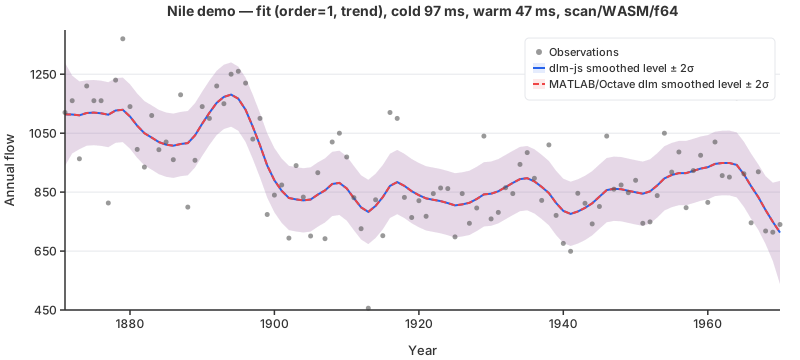
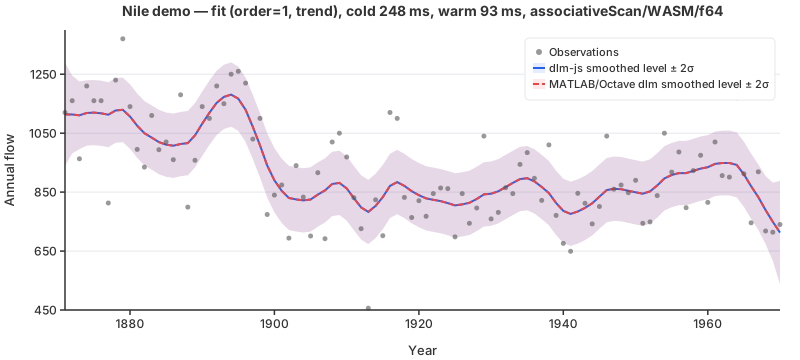
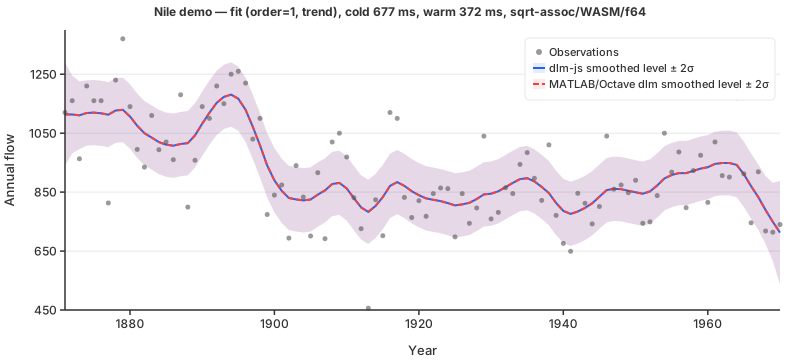
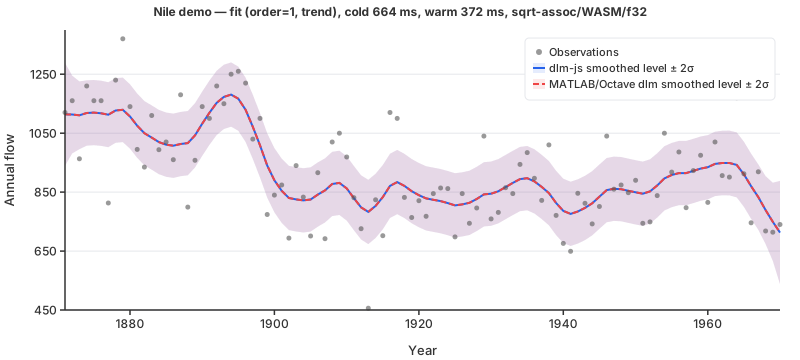
First smoothed state (level) smoothed[0] from dlm-js (solid blue) vs MATLAB/Octave dlm (dashed red), with ± 2σ bands from smoothedStd[:,0] (state uncertainty, not observation prediction intervals).
Kaisaniemi Monthly Temperatures (Seasonal)
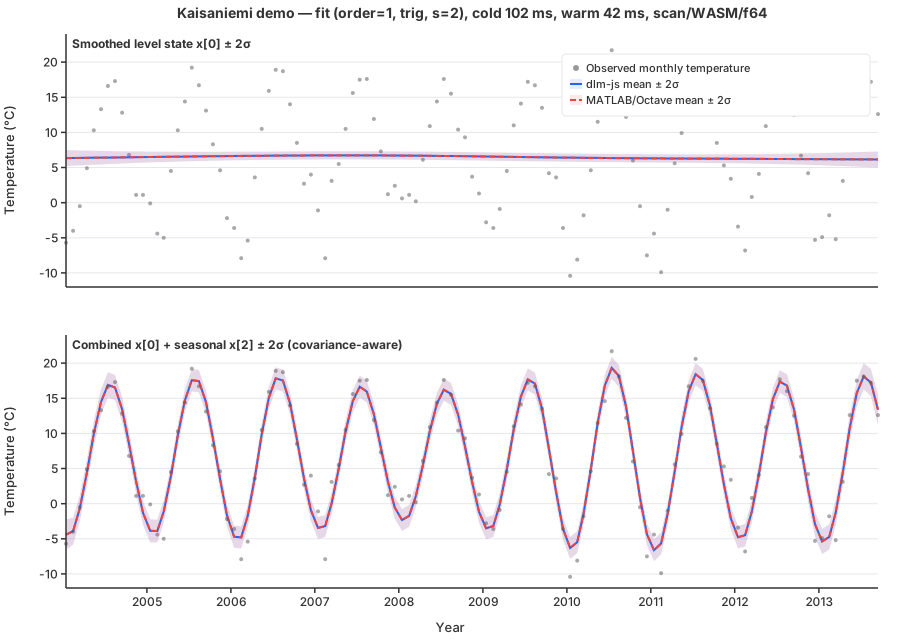
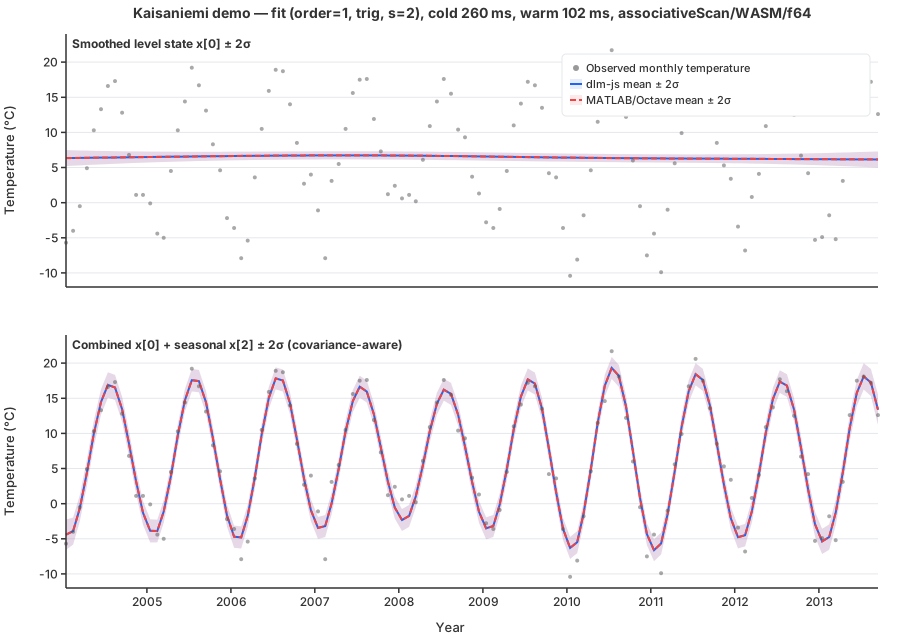
Top panel: level state smoothed[0] ± 2σ. Bottom panel: covariance-aware combined signal smoothed[0]+smoothed[2] ± 2σ, using Var(x0+x2)=Var(x0)+Var(x2)+2Cov(x0,x2). Model settings: order=1, harmonics=1, obsStd=2, processStd=[0,0.005,0.4,0.4].
Energy Demand (Seasonal + AR)
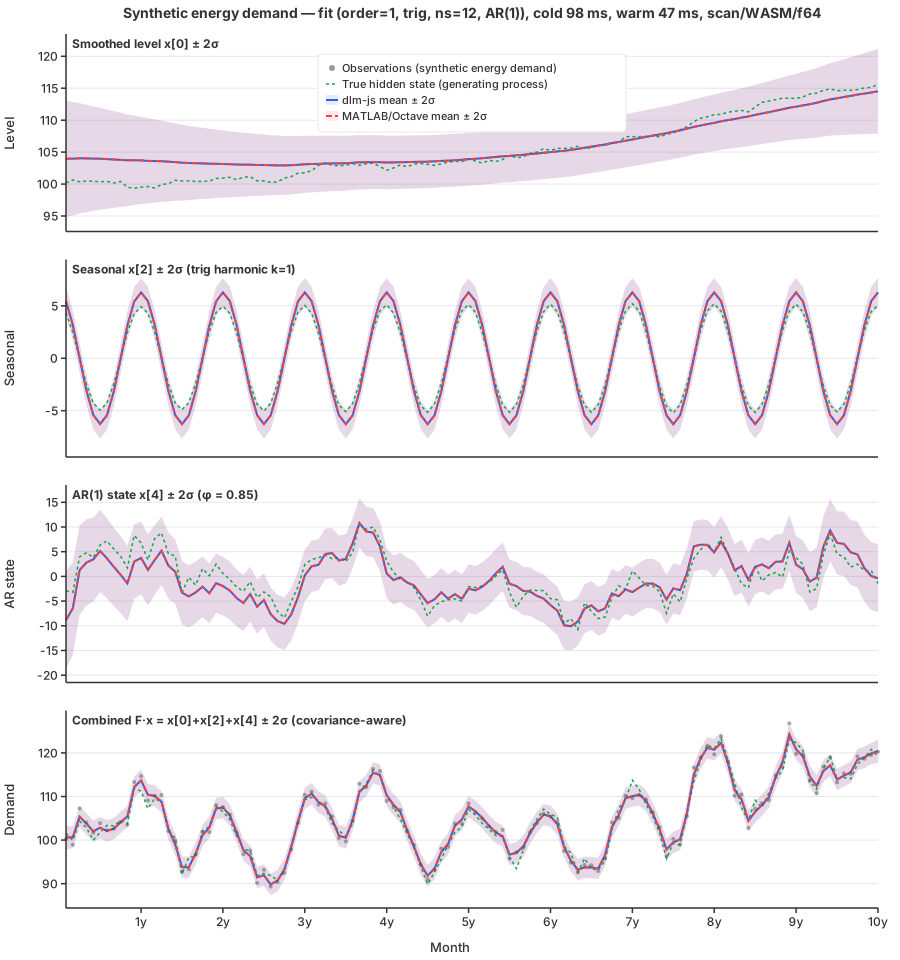
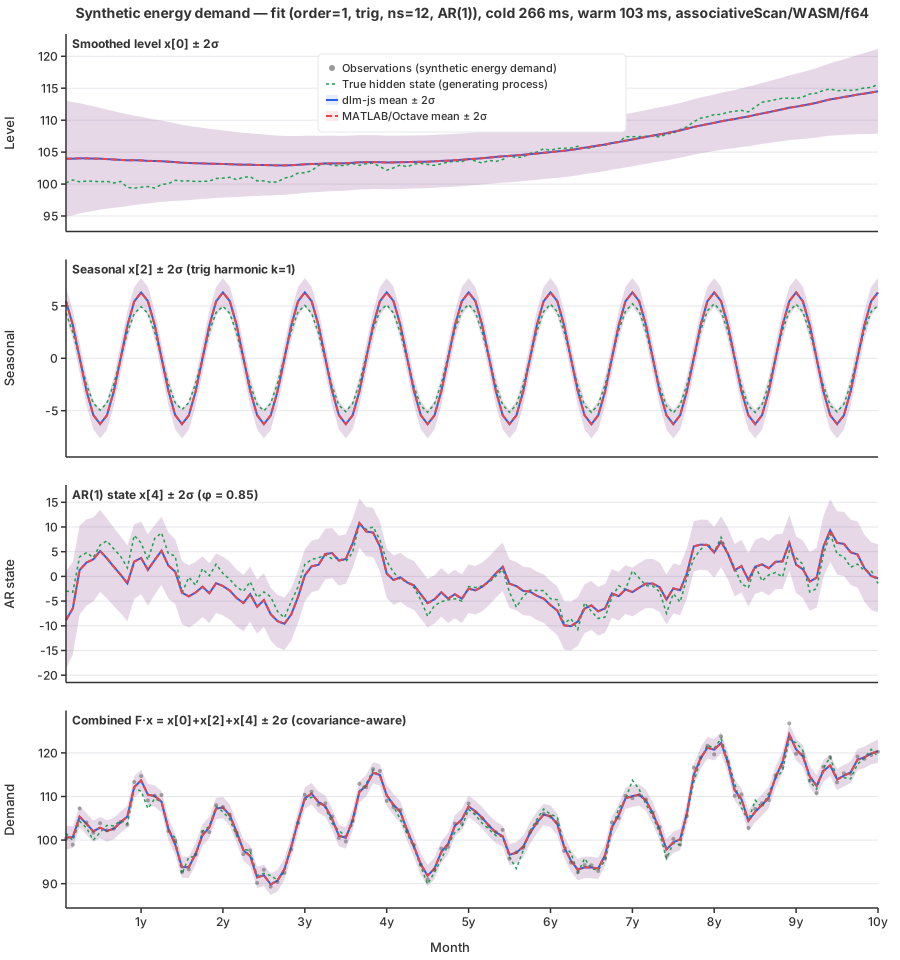
Synthetic 10-year monthly data. Panels top to bottom: smoothed level smoothed[0] ± 2σ, trigonometric seasonal smoothed[2] ± 2σ, AR(1) state smoothed[4] ± 2σ, and covariance-aware combined signal F·x = smoothed[0]+smoothed[2]+smoothed[4] ± 2σ. True hidden states (green dashed) are overlaid. Model settings: order=1, harmonics=1, seasonLength=12, arCoefficients=[0.85], obsStd=1.5, processStd=[0.3,0.02,0.02,0.02,2.5], m=5.
Stratospheric Ozone Trend Analysis
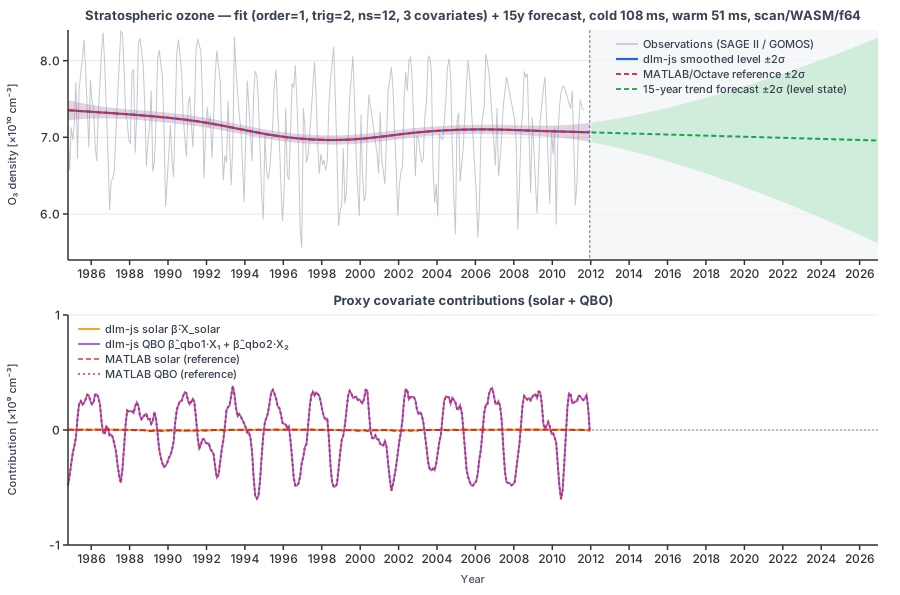
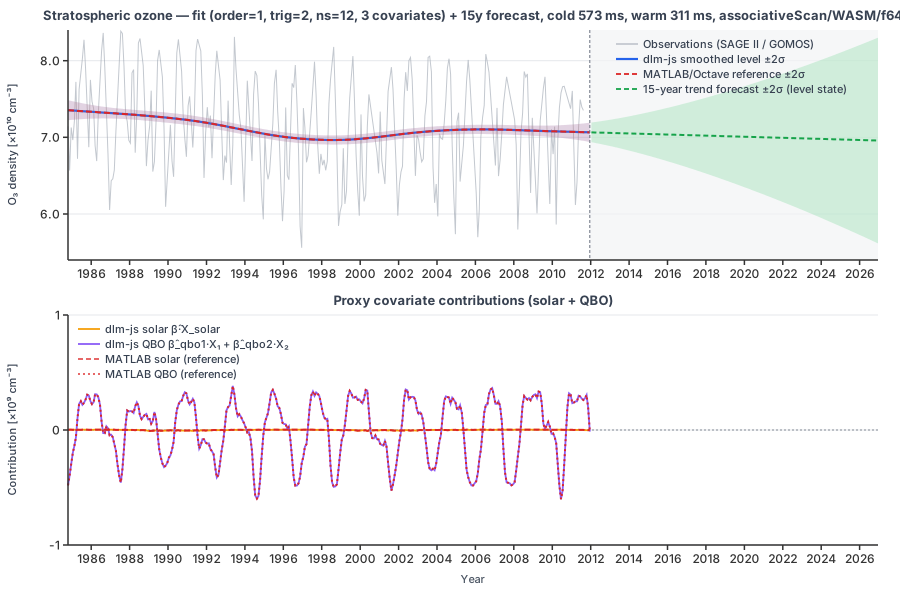
Top panel: O₃ density (SAGE II / GOMOS observations, 1984–2011) with smoothed level state ± 2σ and a 15-year dlmForecast trend extrapolation. Bottom panel: proxy covariate contributions — solar cycle (β̂·X_solar, amber) and QBO (β̂_qbo1·X₁ + β̂_qbo2·X₂, purple). Model: order=1, harmonics=2, seasonLength=12, 3 static-β covariates, state dimension m=9.
Missing Data (NaN observations)
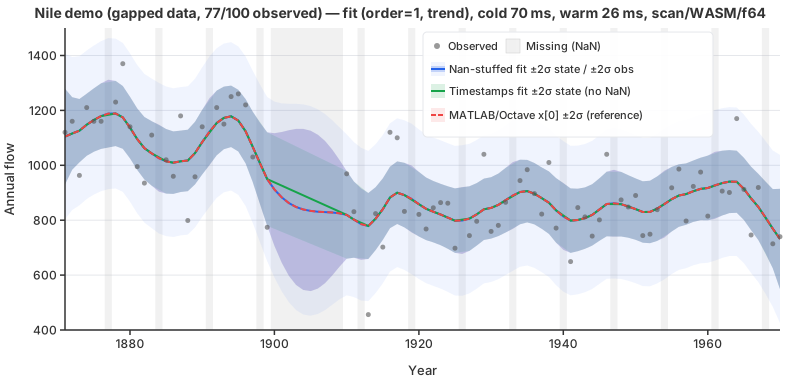
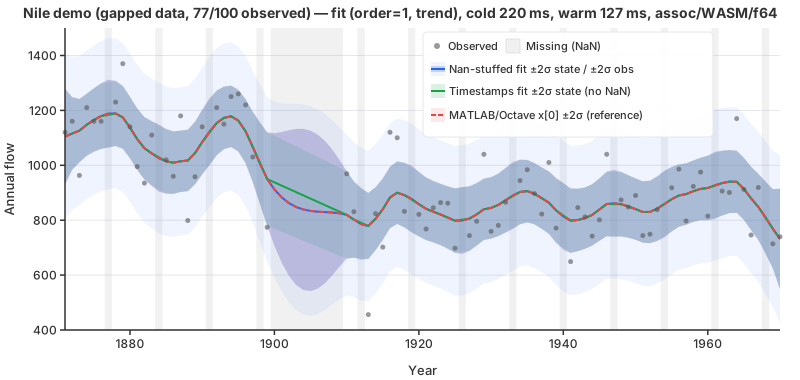
Nile flow (n=100) with 23 NaN observations. Gray bands mark missing timesteps. Outer light band: observation prediction interval F·x_smooth ± 2·ystd; inner opaque band: state uncertainty smoothed[0] ± 2·smoothedStd[0]. The smoother interpolates continuously through all gaps with no extra configuration.
Multivariate Observations (p = 2)


Two sensors observing the same local linear trend state (order=1, m=2, p=2). Each panel shows one sensor's observations with the shared smoothed level ± 2σ bands. Sensor 2 has higher observation noise — the smoother correctly down-weights it. Both scan and assoc algorithms support p > 1; sqrt-assoc, ud, and dlmForecast throw for p > 1. Validated against Octave reference (multivariate.test.ts: 48 tests — order=1, order=0, gapped, order=1+AR(2) × scan/assoc × all backends).
Algorithm compatibility
| Feature | scan |
assoc |
sqrt-assoc |
ud |
|---|---|---|---|---|
| Multivariate ( |
✅ | ✅ | ❌ throws | ❌ throws |
dlmMLE |
✅ | ✅ | ❌ not wired | ❌ not wired |
dlmForecast |
✅ | ✅ | ✅ | ✅ |
| Float32 stabilization | Joseph form (auto) | built-in | built-in (Cholesky) | built-in (UD factors) |
| Parallel ( |
❌ sequential | ✅ | ✅ | ❌ sequential |
| Default backend | cpu, wasm | webgpu | — (explicit) | — (explicit) |
scan algorithm
algorithm: 'scan' uses sequential lax.scan for both the Kalman forward filter and RTS backward smoother. It is the default when algorithm is not set and the assoc path is not auto-selected.
The dominant error source is not summation accuracy — it is catastrophic cancellation in the RTS backward smoother step C_smooth = C - C·N·C. When the smoothing correction nearly equals the prior covariance, the subtraction amplifies any rounding in the operands. Kahan summation in jax-js-nonconsuming cannot fix this because it only improves the individual dot products, not the outer subtraction. See detailed comments in src/index.ts.
Float32 stabilization (Joseph form): When dtype: 'f32', the scan path automatically uses Joseph-form stabilization, replacing the standard covariance update C_filt = C_pred - K·F·C_pred with:
This is algebraically equivalent but numerically more stable — it guarantees a positive semi-definite result even with rounding. Combined with explicit symmetrization ((C + C') / 2), this prevents the covariance from going non-positive-definite for m ≤ 2. Without Joseph form, Float32 + scan is numerically unstable for m ≥ 4. Float32 is still skipped in tests for m > 2 even with Joseph form, due to accumulated rounding in the smoother.
Approaches attempted and rejected:
- Diagonal preconditioning — Rescale the state space by
so the filter operates on a better-conditioned system, then untransform the results. Improved joseph+triu precision 2–5× for polynomial models (m ≤ 2), but degraded m = 1 models by ~85× and catastrophically broke trigonometric/seasonal models (max |Δ|% > 300,000%) because diagonal scaling distorts the rotation blocks in non-triangular G matrices. Reverted. - Iterative refinement — Re-run the smoother using the smoothed state x[0] and covariance C[0] as the initial state for each additional pass. Three C₀ strategies tested (×100, ×1, x₀-only). All variants were consistently 5–4,550× worse across all five benchmark models. The Float32 precision bottleneck is per-timestep rounding accumulation in the forward/backward recursions, not initialization quality — the existing two-pass scheme (diffuse prior → refined) already handles initialization optimally. Reverted.
MATLAB DLM comparison: The dlmsmo.m reference uses the standard covariance update formula (not Joseph form), combined with explicit triu + triu' symmetrization after each filter step (line 77) and abs(diag(C)) diagonal correction on smoother output (line 114). The improved match seen in the benchmark between dlm-js+joseph/f64 and the Octave reference (9.38e-11 vs 3.78e-8 max |Δ| for f64 without joseph) is not a coincidence — both approaches enforce numerical stability in similar ways, pushing both implementations toward the same stable numerical attractor.
assoc algorithm
algorithm: 'assoc' uses lax.associativeScan to evaluate the exact O(log N) parallel Kalman filter + smoother from Särkkä & García-Fernández (2020) [1], Lemmas 1–4. Pass { algorithm: 'assoc' } in the options to use it on any backend and any dtype. The assoc path always applies its own numerically stable formulation.
Both passes dispatch ⌈log₂N⌉+1 kernel rounds (Kogge-Stone), giving O(log n) total depth. Results are numerically equivalent to scan to within floating-point reordering (validated by assocscan.test.ts).
- Forward filter (exact 5-tuple from [1, Lemmas 1–2]): Constructs per-timestep 5-tuple elements
with exact Kalman gains per Lemma 1, composed via lax.associativeScanusing Lemma 2 with regularized inverse and push-through identity. No approximation — produces the same filtered states as sequentialscan, up to floating-point reordering. - Backward smoother ([1], Lemmas 3–4; see also Theorem 2): Exact per-timestep smoother gains
per Lemma 3, computed from the forward-filtered covariances via batched np.linalg.inv. Smoother elements— dlm-js replaces the standard-form (Lemma 3) with a Joseph-form variant for numerical stability — composed via lax.associativeScan(compose, elems, { reverse: true })(suffix scan). No accuracy loss — the backward smoother is algebraically equivalent to sequential RTS.
Combined with a WebGPU backend, this provides two orthogonal dimensions of parallelism: across time steps (O(log n) depth via associativeScan) and within each step's matrix operations (GPU ALUs). The same technique is used in production by Pyro's GaussianHMM [2] and NumPyro's parallel HMM inference [3]. Both EEA-sensors JAX implementations [5][6] use the same 5-tuple forward / 3-tuple backward formulation and 0.5*(C + C') symmetrization after each composition — confirming the numerical stability approach used by dlm-js.
Design choices
| Aspect | Choice | Rationale |
|---|---|---|
| Exact 5-tuple elements | Per-timestep |
Each timestep has its own Kalman gain — exact, no approximation. |
| Regularized inverse in compose | Guards against near-singular matrices at degenerate (NaN/zero-J) compose steps. |
|
| Push-through identity | Derives the second inverse from the first — only one np.linalg.inv call per compose step. |
|
np.where NaN blending |
Boolean-conditioned blending between observed and missing-step elements. AD-safe since jax-js 297f93a (np.where VJP). Remaining scalar zeroing sites use np.multiply(mask, x). |
|
| Scan output disposal | Individual scanned.*.dispose() after x_filt and C_filt recovery |
Safe because np.add produces new arrays — x_filt and C_filt are independent of the scan pytree. |
Square-root parallel smoother (sqrt-assoc)
algorithm: 'sqrt-assoc' implements the square-root associative-scan smoother from Yaghoobi et al. [6], reformulating the parallel filter + smoother in Cholesky-factor space. The forward 5-tuple becomes (C+C')/2 symmetrization, and cEps regularization.
Both passes use lax.associativeScan with ⌈log₂N⌉+1 rounds, same as the standard assoc path. Results are validated against the same Octave ground truth (sqrtassoc.test.ts; 24 tests on wasm — f64: precision comparison for all models including fullSeasonal m=13, f32: all-outputs-finite smoke test for all models including fullSeasonal m=13) and on WebGPU (webgpu-scan.test.ts; 5 models) with max relative error ~3e-5 (f64).
const result = await dlmFit(y, {
obsStd: 10,
processStd: [5, 2],
algorithm: 'sqrt-assoc',
});
Deviations from the reference
The [6] reference implementation (JAX, EEA-sensors/sqrt-parallel-smoothers) uses jnp.linalg.qr, jnp.block, and jax.scipy.linalg.solve_triangular. dlm-js now matches the reference for tria() and triangular solves; remaining deviations:
| Operation | Reference [6] | dlm-js | Reason | Impact |
|---|---|---|---|---|
tria(A) |
_, R = qr(Aᵀ); Rᵀ |
_, R = qr(Aᵀ); Rᵀ |
✅ Same | Proper QR-based tria — no condition-number squaring. Works for all state dimensions (m=13 fullSeasonal verified). |
| Block matrices | jnp.block([[A, B], [C, D]]) |
np.concatenate along last two axes |
jax-js np.block doesn't handle batch dims |
Equivalent; verbose but correct. |
| Triangular solve | solve_triangular(L, B) |
lax.linalg.triangularSolve(L, B) |
✅ Same | Proper triangular back-substitution; faster than general LU solve. |
| Dense |
Rank-1 column + zero padding | Observation dimension |
||
| Scalar |
solve_triangular(Ψ_{11}, ·) |
np.divide(·, Ψ_{11}) |
Exact; avoids unnecessary matrix solve for scalar denominator. |
Known limitations
: Throws for multivariate observations. The Cholesky-factor composition assumes scalar . - MLE: The sqrt-assoc path is not yet wired into
dlmMLE/makeKalmanLoss. Usealgorithm: 'scan'or'assoc'for MLE.
UD factorization (ud)
algorithm: 'ud' replaces the dense covariance matrix
The UD path uses sequential lax.scan for the forward filter (like scan) and reuses the standard RTS backward smoother unchanged. It targets the same use case as scan with Joseph form — Float32 stabilization — but aims for lower numerical error by avoiding the
const result = await dlmFit(y, {
obsStd: 120,
processStd: [40, 10],
order: 1,
dtype: 'f32',
algorithm: 'ud',
});
Forward step (Bierman measurement + Thornton time update)
Each forward step takes the carry
1. Reconstruct
This is emitted as
2. Innovation.
3. Bierman measurement update (scalar observation,
After the loop,
Note: The classical Bierman/Thornton presentation uses unit upper-triangular
. We use unit lower-triangular because np.linalg.choleskyreturns lower-triangular, making the natural factorization without any transpose. The column-loop direction is reversed accordingly ( down to ).
4. State update.
5. Thornton time update (modified weighted Gram-Schmidt). Given the Bierman-updated factors
- Decompose
. For diagonal (all dlm-js models), and , extracted directly without Cholesky to avoid contamination. - Form the augmented matrix
and its companion , with weight vectors and . - MWGS: for
:
The output
6. Carry and outputs. The updated carry is
Backward smoother
The backward pass is the standard sequential RTS smoother (same function as the scan path), operating on the
Design choices
| Aspect | Choice | Rationale |
|---|---|---|
| Factorization convention | Unit lower-triangular |
Cholesky gives lower-tri |
| Measurement update | Bierman column loop ( |
Scalar-observation processing; produces gain |
| Time update | Thornton MWGS on augmented |
Propagates UD factors directly; no Cholesky re-factorization of |
| Explicit diagonal extraction of |
||
| Column loop order | Lower-tri convention: free entries at |
|
| Backward smoother gain |
Predicted-convention gain from Bierman's exact |
|
| NaN masking | Entire Bierman loop becomes a no-op: |
|
| Scope | Bierman's column loop is scalar-observation-specific; |
Known limitations
: UD factorization currently supports scalar observations only ( ). Throws for multivariate observations. - MLE: Not yet wired into
dlmMLE. Usealgorithm: 'scan'or'assoc'for MLE.
References
- Bierman, G. J. (1977). Factorization Methods for Discrete Sequential Estimation. Academic Press.
- Thornton, C. L. (1976). Triangular Covariance Factorizations for Kalman Filtering. Ph.D. Thesis, UCLA. NASA Tech. Memo. 33-798.
- Grewal, M. S. & Andrews, A. P. (2001). Kalman Filtering: Theory and Practice Using MATLAB. Wiley. Algorithm 6.1.
Backend performance
dlmFit warm-run timings (jitted core, second of two sequential runs) and maximum errors vs. the Octave/MATLAB reference (worst case across all 5 models and all outputs: yhat, ystd, smoothed, smoothedStd) for each backend × dtype × algorithm × stabilization combination. Regenerate with pnpm run bench:full. Bold rows are the auto-selected default per backend × dtype.
Stab column: triu = triu(C)+triu(C,1)' symmetrize (f64 default, matches MATLAB); joseph = Joseph-form covariance update + (C+C')/2 symmetrize (f32/scan default, always on); joseph+triu = Joseph form + triu symmetrize instead of (C+C')/2 (explicit stabilization:{cTriuSym:true}); built-in = assoc/sqrt-assoc/ud paths use their own exact per-timestep formulation (no external flag); off = explicit override disabling the default (stabilization:{cTriuSym:false}).
Models: Nile order=0 (n=100, m=1) · Nile order=1 (n=100, m=2) · Kaisaniemi trig (n=117, m=4) · Energy trig+AR (n=120, m=5) · Gapped order=1 (n=100, m=2, 23 NaN). Benchmarked on: Intel(R) Core(TM) Ultra 5 125H, 62 GB RAM · GPU: GeForce RTX 4070 Ti SUPER (WebGPU adapter).
| backend | dtype | algorithm | stab | Nile o=0 | rel err | Nile o=1 | rel err | Kaisaniemi | rel err | Energy | rel err | E.demand | rel err | Gapped | rel err |
|---|---|---|---|---|---|---|---|---|---|---|---|---|---|---|---|
| cpu | f64 | scan | triu | 167 ms | 1.73e-16 | 354 ms | 4.78e-13 | 443 ms | 4.20e-11 | 492 ms | 1.19e-11 | 507 ms | 1.82e-11 | 366 ms | 2.52e-13 |
| scan | off | 148 ms | 1.73e-16 | 279 ms | 1.40e-11 | 359 ms | 5.85e-10 | 398 ms | 1.06e-6 | 404 ms | 2.09e-4 | 289 ms | 1.03e-12 | ||
| assoc | built-in | 78 ms | 4.87e-12 | 210 ms | 4.36e-9 | 1010 ms | 3.17e-8 | 1805 ms | 2.17e-7 | 1816 ms | 2.28e-7 | 204 ms | 1.29e-9 | ||
| ud | built-in | 233 ms | 1.94e-14 | 569 ms | 1.59e-12 | 1066 ms | 4.01e-5 | 1314 ms | 1.55e-10 | 1434 ms | 7.19e-9 | 584 ms | 3.60e-13 | ||
| f32 | scan | joseph | 156 ms | 9.93e-7 | 329 ms | 2.25e-4 | 420 ms | 2.93e-3 | 471 ms | 6.18e-4 | 468 ms | 0.13 | 333 ms | 1.74e-5 | |
| scan | joseph+triu | 183 ms | 9.93e-7 | 364 ms | 1.09e-4 | 480 ms | 8.98e-3 | 537 ms | 1.41e-3 | 531 ms | 8.40e-3 | 377 ms | 1.40e-4 | ||
| assoc | built-in | 67 ms | 4.74e-6 | 205 ms | 3.93e-3 | 1029 ms | 0.03 | 1822 ms | 0.20 | 1845 ms | 0.22 | 211 ms | 1.51e-3 | ||
| ud | built-in | 222 ms | 9.93e-7 | 555 ms | 7.58e-4 | 1061 ms | 9.21e-3 | 1301 ms | 2.07e-3 | 1314 ms | 0.03 | 575 ms | 1.24e-5 | ||
| wasm | f64 | scan | triu | 5 ms | 1.73e-16 | 5 ms | 4.78e-13 | 5 ms | 4.20e-11 | 5 ms | 1.19e-11 | 5 ms | 1.82e-11 | 5 ms | 2.52e-13 |
| scan | off | 4 ms | 1.73e-16 | 4 ms | 1.40e-11 | 5 ms | 5.85e-10 | 4 ms | 1.06e-6 | 5 ms | 2.09e-4 | 5 ms | 1.03e-12 | ||
| assoc | built-in | 17 ms | 4.87e-12 | 19 ms | 4.36e-9 | 41 ms | 3.17e-8 | 57 ms | 2.17e-7 | 52 ms | 2.28e-7 | 20 ms | 1.29e-9 | ||
| sqrt-assoc | built-in | 68 ms | 2.60e-15 | 113 ms | 3.55e-12 | 283 ms | 2.03e-6 | 369 ms | 1.70e-10 | 363 ms | 9.88e-7 | 109 ms | 1.94e-13 | ||
| ud | built-in | 17 ms | 1.94e-14 | 19 ms | 1.59e-12 | 30 ms | 4.01e-5 | 40 ms | 1.55e-10 | 37 ms | 7.19e-9 | 19 ms | 3.60e-13 | ||
| f32 | scan | joseph | 4 ms | 1.06e-6 | 4 ms | 2.59e-4 | 4 ms | 0.01 | 4 ms | 2.08e-3 | 4 ms | 0.07 | 4 ms | 1.32e-4 | |
| scan | joseph+triu | 4 ms | 1.06e-6 | 5 ms | 7.11e-4 | 6 ms | 0.02 | 5 ms | 1.34e-3 | 5 ms | 0.10 | 5 ms | 2.48e-4 | ||
| assoc | built-in | 15 ms | 4.74e-6 | 18 ms | 4.53e-3 | 41 ms | 0.03 | 54 ms | 0.22 | 49 ms | 0.07 | 20 ms | 1.19e-3 | ||
| sqrt-assoc | built-in | 66 ms | 7.50e-7 | 111 ms | 1.41e-3 | 244 ms | 1.98 | 327 ms | 0.02 | 323 ms | 1.13 | 107 ms | 6.93e-4 | ||
| ud | built-in | 14 ms | 1.06e-6 | 17 ms | 3.44e-4 | 30 ms | 5.68e-3 | 35 ms | 6.09e-4 | 35 ms | 0.09 | 18 ms | 2.90e-5 | ||
| webgpu | f32 | assoc | built-in | 30 ms | 4.74e-6 | 35 ms | 4.28e-3 | 58 ms | 0.03 | 62 ms | 0.18 | 61 ms | 0.09 | 35 ms | 4.07e-4 |
| scan | joseph | 88 ms | 3.99e-6 | 88 ms | 6.34e-5 | 97 ms | 9.85e-3 | 103 ms | 1.06e-3 | 100 ms | 0.02 | 88 ms | 2.56e-5 | ||
| scan | joseph+triu | 77 ms | 3.99e-6 | 76 ms | 6.34e-5 | 81 ms | 0.03 | 68 ms | 2.88e-3 | 57 ms | 0.17 | 64 ms | 8.20e-5 | ||
| ud | built-in | 172 ms | 9.71e-6 | 222 ms | 2.67e-4 | 346 ms | 0.02 | 335 ms | 2.44e-3 | 271 ms | 9.01e-3 | 198 ms | 2.19e-4 |
Each cell shows warm timing and max relative error vs Octave. Errors are per-model, per output variable (yhat, ystd, smoothed, smoothedStd); the Octave reference value is the denominator. Percentages >1% in assoc and sqrt-assoc rows come from small smoothedStd values (not from yhat/ystd). The sqrt-assoc path uses QR-based tria() and lax.linalg.triangularSolve — covariances are stored as Cholesky factors, ensuring PSD by construction. On cpu, sqrt-assoc has large errors for m > 1 due to the JS interpreter's numerical behaviour; use wasm.
Note: The "Energy" column uses trigar-in.json (AR(1), coeff=0.7, m=5). The "E.demand" column uses energy-in.json (AR(1), coeff=0.85, m=5) — a numerically harder model with tighter obs noise (s=1.5 vs 5) and larger AR process noise (w₅=2.5 vs 1, 15 625× dynamic range in W diagonal). Previously, E.demand diverged to NaN with UD + Float32 on WASM/WebGPU — fixed by using α_old/α directly in the Bierman D update instead of (α − f·g)/α, which suffered catastrophic cancellation when f·g ≫ α_old.
Key findings (see table above for exact numbers):
- WASM is ~30–90× faster than CPU for these small models. The JS interpreter has significant per-operation overhead.
assocon CPU is faster for small m, slower for large m. For m≥4 the extra matrix compositions dominate (~3× slower thanscan).assocon WASM is slower thanscan— the 5-tuple composition overhead dominates at small n. Preferscanon WASM unless the parallel formulation is explicitly required.sqrt-assocmatches reference precision on wasm/f64 and maintains PSD covariances structurally (Cholesky factors) — no Joseph form or symmetrization needed. Slower thanscandue to QR decompositions per composition step.- Stabilization is auto-selected per dtype — f64 uses
cTriuSym(triu symmetrize, matching MATLABdlmsmo.m), f32 uses Joseph-form update. Theassoc/sqrt-assocpaths use their own exact formulation regardless of dtype. Overhead is negligible on WASM. Disable f64 symmetrization withstabilization: { cTriuSym: false }. - f32 precision is limited to ~1–4% max error for large models. Use f64 when accuracy matters; f32 is safe for all state dimensions with the default stabilization.
- WebGPU
associs faster thanscan—assocdispatches O(log n) rounds via a singlequeue.submit(), whilescandispatches O(n) sequential rounds. At small n (100–120),associs ~1.5–3× faster; the gap widens with larger n (see scaling table below). - WASM stays flat up to N≈3200, then scales linearly (~1431 ms (warm) at N=1.6M). WebGPU scales sub-linearly at small N but approaches O(N) at large N (1295 ms (cold) → 2485 ms (cold) for a 1024× increase). No crossover was observed up to N=1.6M; see scaling table.
- WebGPU numerical differences vs WASM/f64 are from Float32 precision and parallel scan reordering, not algorithmic approximation — both paths use exact per-timestep Kalman gains.
For background on the Nile and Kaisaniemi demos and the original model formulation, see Marko Laine's DLM page. The energy demand demo uses synthetic data generated for this project. The gapped-data demo uses the same Nile dataset with 23 observations removed.
WebGPU/f32/assoc vs WASM/f64/scan warm-run benchmark
dlmFit warm-run timings (jitted core, second of two runs):
| Model | wasm / f64 / scan (warm) | webgpu / f32 / assoc (warm) | ||
|---|---|---|---|---|
| Nile, order=0 | 100 | 1 | 6 ms | 39 ms |
| Nile, order=1 | 100 | 2 | 6 ms | 35 ms |
| Kaisaniemi, trig | 117 | 4 | 6 ms | 62 ms |
| Energy, trig+AR | 120 | 5 | 6 ms | 64 ms |
WebGPU/f32/assoc vs WASM/f64/scan scaling: O(log n) vs O(n).
A scaling benchmark (Nile order=1, m=2) measures dlmFit at exponentially increasing N. WASM jit() is polymorphic in N (one JIT compilation covers all array sizes), so WASM timings are warm (4 runs, median). WebGPU jit() is not polymorphic in N (each new N recompiles), so WebGPU timings are cold (single first call including JIT). WASM uses sequential scan; WebGPU uses assoc (both forward filter and backward smoother via lax.associativeScan):
| N | wasm/f64/scan (warm) | webgpu/f32/assoc (cold) | ratio |
|---|---|---|---|
| 100 | 7 ms | 1295 ms | 181× |
| 200 | 6 ms | 1306 ms | 227× |
| 400 | 6 ms | 1650 ms | 272× |
| 800 | 7 ms | 1641 ms | 247× |
| 1600 | 7 ms | 1626 ms | 228× |
| 3200 | 8 ms | 1717 ms | 220× |
| 6400 | 11 ms | 1863 ms | 179× |
| 12800 | 17 ms | 1998 ms | 128× |
| 25600 | 33 ms | 2023 ms | 79× |
| 51200 | 55 ms | 2223 ms | 50× |
| 102400 | 83 ms | 2485 ms | 27× |
| 204800 | 172 ms | 2850 ms | 20× |
| 409600 | 339 ms | 3796 ms | 12× |
| 819200 | 698 ms | 6019 ms | 9.1× |
| 1638400 | 1431 ms | 9792 ms | 7.4× |
Three findings:
-
WASM stays flat up to N≈3200, then grows roughly linearly (O(n)). The per-step cost asymptotes around ~0.8 µs/step (1431 ms (warm) at N=1638400). The flat region reflects fixed JIT/dispatch overhead, not compute. WASM OOM previously occurred at N=3276800 due to a signed 32-bit integer overflow in the page-count calculation — fixed upstream in jax-js-nonconsuming (bb126c6+a6d37da).
-
WebGPU cold timings include per-N JIT recompilation (WebGPU
jit()is not polymorphic in N). At small N the ~1200 ms JIT overhead dominates; at large N the GPU arithmetic dominates. Each associativeScan pass dispatches ⌈log₂N⌉+1 Kogge-Stone rounds, each operating on all N elements in parallel — so total GPU work is O(N log N), while WASM sequential scan is O(N). A 1024× increase from N=100 to N=102400 roughly doubles the runtime (1295 ms (cold) → 2485 ms (cold)). -
The cold-WebGPU-to-warm-WASM ratio decreases as N grows (~180× at small N where JIT overhead dominates, ~7× at N=1.6M where GPU execution time dominates). No crossover was observed up to N=1638400.
MLE
Demos
Nile MLE Optimization
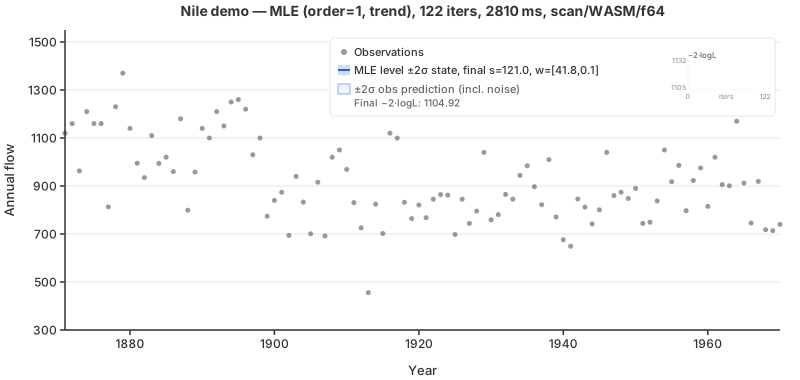
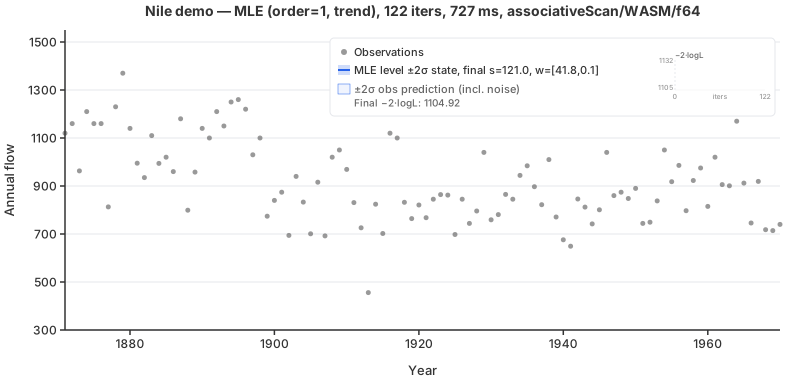
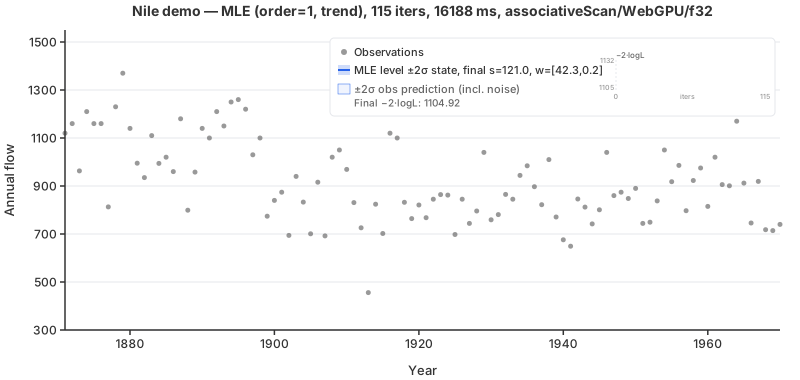
Parameter estimation via autodiff (dlmMLE). The animated SVG shows iteration-by-iteration convergence of the level ± 2σ bands. WASM variants use natural gradient (second-order); WebGPU uses natural gradient for Nile. Estimated observation noise s = 121.1 (known: 122.9), −2·log-likelihood = 1105.0. WebGPU is slower than WASM at n=100 due to dispatch overhead, but pays off at large N.
Energy MLE Optimization (with AR estimation)
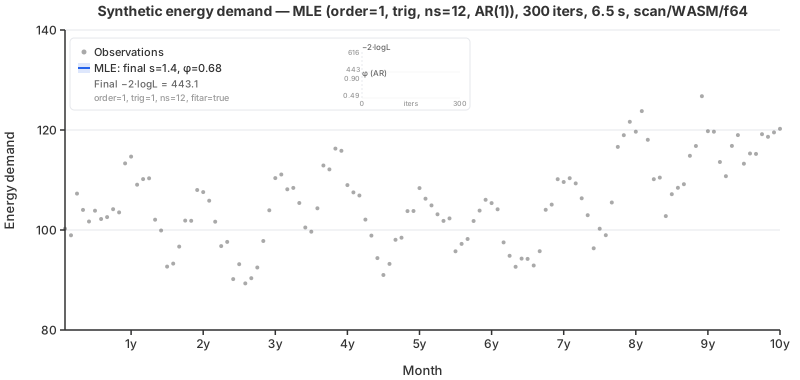
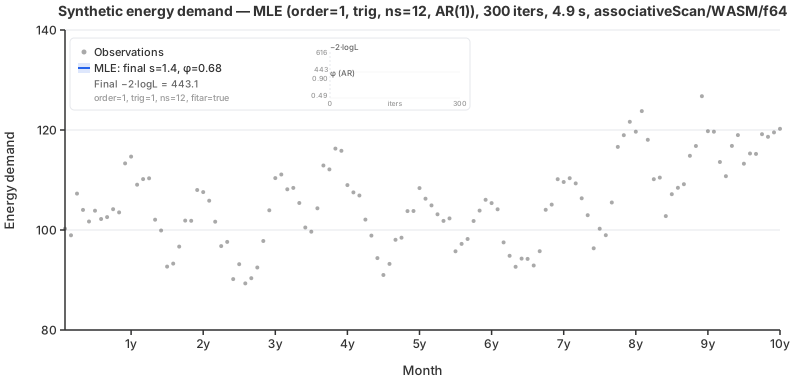
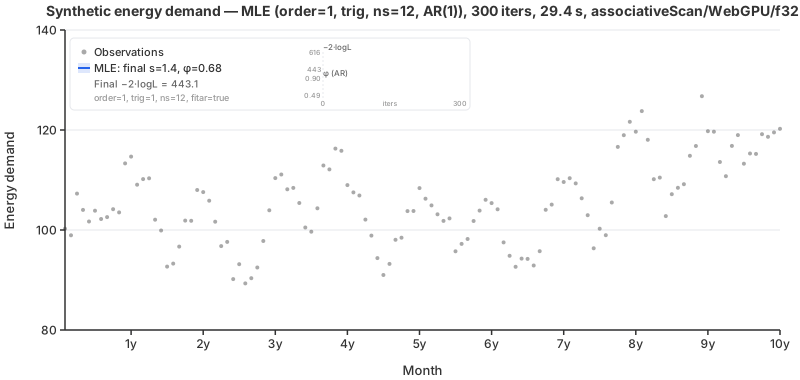
Joint estimation of observation noise s, state variances w, and AR(1) coefficient φ via autodiff (dlmMLE with params.arCoefficients.fit: true). WASM variants use natural gradient; WebGPU uses Adam (FD Hessian too noisy in f32 for 7 parameters). Two sparklines track convergence: −2·log-likelihood (amber) and AR coefficient φ (green, 0.50 → 0.68, true: 0.85).
The Nile MLE demo estimates obsStd and processStd on the classic Nile dataset; the energy MLE demo jointly estimates obsStd, processStd, and AR coefficient φ on the synthetic energy model (params.arCoefficients.fit: true). See Parameter estimation (MLE & MAP): MATLAB DLM vs dlm-js for details.
How MLE works
Noise parameters are optimized in log-space:
The entire optimization step is wrapped in a single jit() call. For Adam, this includes valueAndGrad(loss) (Kalman filter forward pass + AD backward pass) and optax Adam parameter update; for natural gradient, the jit(valueAndGrad(loss)) call is reused for both the gradient and finite-difference Hessian evaluations. The jit() compilation happens on the first iteration; subsequent iterations run from compiled code.
Performance: on the wasm backend, one Nile MLE run (100 observations, m = 2) converges in 190 iterations (~39 ms) with Adam (b2=0.9), or 15 iterations (~23 ms) with the natural gradient optimizer.
Two loss paths: dlmMLE dispatches between two loss functions based on the dtype and backend:
- CPU/WASM (any dtype):
makeKalmanLoss— sequentiallax.scanforward filter (O(n) depth per iteration). For the energy demo (n=120, 19 iters, ~0.3 s on WASM). - WebGPU + Float32:
makeKalmanLossAssoc—lax.associativeScanforward filter (O(log n) depth per iteration). Details below.
Both paths are wrapped in jit(valueAndGrad(lossFn)). The final refit after convergence calls dlmFit (which itself uses the parallel path on WebGPU).
makeKalmanLossAssoc — parallel MLE loss via associative scan
The parallel MLE loss function replaces the sequential Kalman forward pass inside valueAndGrad with the exact 5-tuple forward filter from [1, Lemmas 1–2]. Each timestep produces per-step Kalman gains directly. Gradients propagate through
Step-by-step derivation:
-
Parameter extraction (traced):
. Observation variance (scalar, unless params.obsStd.fixedis used); state noisefrom the full expanded process-noise vector (after applying params.processStd.groupsandparams.processStd.fixed);is updated with AR coefficients when params.arCoefficients.fitis enabled. -
Per-timestep 5-tuple elements (Lemma 1): For each timestep
: Missing timesteps (
): , , , , . Blending uses float-mask arithmetic for clean autodiff behavior.
-
First element (exact prior initialization):
, , , , . -
Prefix scan:
lax.associativeScan(composeForward, {A, b, C, η, J})composes allelements in O(log n) depth using Lemma 2: where
(push-through identity — only one matrix inverse per compose step). -
Filtered state/covariance recovery:
Note:
and are new arrays produced by np.add, not aliases of the scan output — the scan pytree is safely disposed immediately after. -
One-step-ahead predictions (shift): The prediction-error likelihood requires
and (the predicted state before observing ): -
Log-likelihood (prediction-error decomposition):
This is the same objective as the sequential path — both minimize the Kalman filter prediction-error decomposition.
Optimizers
dlmMLE supports two optimizers, selected via optimizer: 'natural' or optimizer: 'adam'. The default depends on dtype: natural gradient for f64 (second-order, fast convergence), Adam for f32 (FD Hessian too noisy in single precision). Both operate on the same differentiable loss function — the Kalman filter prediction-error decomposition jit(valueAndGrad(lossFn)) for gradients.
Steepest descent framework
Both optimizers can be understood as instances of steepest descent under a norm (Bernstein & Newhouse 2024). Given a loss
where
| Norm on |
Duality map | Update rule | Method |
|---|---|---|---|
| Euclidean: |
Gradient descent | ||
| Hessian: |
Newton / natural gradient |
The Euclidean norm treats all parameter directions equally; the Hessian norm uses local curvature to rescale directions, yielding faster convergence on ill-conditioned objectives.
Adam (first-order, default for f32)
Adam (Kingma & Ba 2015) maintains exponential moving averages of the gradient and squared gradient:
This is a diagonal approximation to natural gradient —
dlm-js defaults: b1=0.9, b2=0.9, eps=1e-8, lr=0.05, maxIter=200. The non-standard b2=0.9 was selected empirically — it converges ~3× faster than the canonical 0.999 on DLM log-likelihoods (measured across Nile, Kaisaniemi, ozone benchmarks). The entire Adam step (forward filter + AD backward pass + Adam state update) is wrapped in a single jit() call.
const mle = await dlmMLE(y, {
order: 1,
optimizer: 'adam', // explicit (default for f32)
maxIter: 300,
lr: 0.05,
dtype: 'f32',
});
Natural gradient (second-order, default for f64, optimizer: 'natural')
The natural gradient optimizer uses second-order curvature information to take Newton-type steps. In the steepest-descent framework above, the norm on
where
Step-by-step algorithm:
-
Gradient evaluation. Compute
via the JIT-compiled valueAndGrad(lossFn). -
Hessian approximation. Two modes:
-
hessian: 'fd'(default): central finite differences of the gradient. For each parameter: Cost:
gradient evaluations reusing the same JIT-compiled gradFn— no extra tracing. For(typical DLM), this is ~200–700 ms on WASM. Result is symmetrized: . -
hessian: 'exact':jit(hessian(lossFn))via AD. Exact but expensive — the first call incurs ~20 s of JIT tracing (jax-js v0.7.8); subsequent calls are fast.
-
-
Marquardt initialization (first iteration only):
, with (default). This starts with moderate damping to avoid overshooting into wrong basins. -
Linear solve. Solve
via Gaussian elimination with partial pivoting. For , this is exact and trivially fast in plain JS. -
Backtracking line search. Try candidate
(default , full Newton step): - If
: accept, shrink damping (trust the quadratic model more). - If
: reject, grow damping , re-solve, retry (up to 6 attempts). - If all attempts fail: fall back to a small gradient-descent step.
Defaults:
, . - If
-
Convergence. Stop when the relative change in
falls below tol(default) or maxIteris reached (default 50).
Why this is effective for DLM MLE: The log-likelihood
Cost trade-off: Each natural gradient iteration is more expensive (
const mle = await dlmMLE(y, {
order: 1,
optimizer: 'natural', // default for f64
maxIter: 50,
naturalOpts: {
hessian: 'fd', // 'fd' (default) or 'exact'
lambdaInit: 0.1, // τ for Marquardt init
lambdaShrink: 0.5, // ρ_shrink: on success
lambdaGrow: 2, // ρ_grow: on failure
fdStep: 1e-5, // h for central differences
},
dtype: 'f64',
});
Parameter estimation (MLE & MAP): MATLAB DLM vs dlm-js
This comparison focuses on the current parameter-estimation workflow for univariate observations (dlmMLE currently estimates scalar-observation models only, even though dlmFit elsewhere in the library also supports multivariate observations (dlmMLE supports both pure MLE (default) and MAP estimation via the loss option — see MAP estimation for API details. For the original MATLAB DLM, see the tutorial and source.
Objective function
Both optimize the same scalar likelihood form (for
where dlm_costfun function (inside dlmfit.m) calls dlmsmo(...,0,0) (filter only, no smoother, no sample) and returns out.lik; we ran this under Octave. The dlm-js makeKalmanLoss in src/mle.ts computes the same per-step terms via lax.scan over the forward filter steps.
In practice, exact numeric equality is not expected because initialization and optimization procedures differ (e.g., dlmfit uses a two-pass prefit for initial state/covariance before optional optimization, as run under Octave).
Parameterization
| Aspect | dlm-js | MATLAB DLM |
|---|---|---|
| Observation noise |
Always fitted: |
Optionally fitted as a multiplicative factor options.fitv) |
| State noise |
buildDiagW |
|
| AR coefficients | Directly optimized (not log-transformed): buildG rank-1 update (AD-safe) |
Directly optimized (not log-transformed): |
| Parameter grouping | params.processStd.groups ties entries of the expanded process-noise vector to shared fitted parameters (MATLAB winds equivalent) |
options.winds maps winds=[1,1,2,2] ties states 1&2 and 3&4) |
Both use the same positivity enforcement: log-space for variance parameters, then options.winds, and dlm-js via params.processStd.groups, which serves the same role for the expanded physical processStd vector.
Optimizer
| Aspect | dlm-js | MATLAB DLM |
|---|---|---|
| Algorithm | Adam (1st-order) or natural gradient (2nd-order, LM-damped Newton) — see Optimizers | fminsearch (Nelder-Mead simplex) |
| Gradient computation | Autodiff via valueAndGrad() + reverse-mode AD through lax.scan |
None — derivative-free |
| Typical run budget | Adam: 200 iterations; natural: 50 iterations | 400 function evaluations (options.maxfuneval) |
| Compilation | jit()-traced optimization step (forward filter + AD + parameter update) |
None (interpreted; tested under Octave, or optional dlmmex C MEX) |
| WASM performance | Adam: 39 ms / 190 iters; natural: 23 ms / 15 iters (Nile, n=100, m=2, incl. JIT) | N/A |
Key tradeoff: Nelder-Mead needs only function evaluations (no gradients), making it robust on non-smooth surfaces but expensive as parameter dimension grows. Adam uses first-order gradients; natural gradient uses second-order curvature (Hessian) for faster convergence on smooth objectives like the DLM log-likelihood. See Optimizers for equations and algorithmic details.
MLE, MAP, and MCMC: three estimation approaches
Pure MLE minimises
MAP estimation (dlm-js loss option) adds prior penalties to the likelihood, regularising the solution without the cost of full posterior sampling. dlm-js provides dlmPrior for MATLAB DLM-style Inverse-Gamma priors on variances and Normal priors on AR coefficients (matching dlmGibbsDIG conventions), or accepts a custom callback for arbitrary penalties. The entire chain — Kalman loss + prior penalty + AD backward pass + optimizer update — is compiled in a single jit() call. The result separates deviance (pure priorPenalty for diagnostics.
MCMC (MATLAB DLM only) uses a normal prior on
| Point | dlm-js MLE | dlm-js MAP | MATLAB MCMC |
|---|---|---|---|
| Ozone |
— | — | 435.6 |
| Ozone |
203.8 | — | — |
| Regularisation | None | Prior penalty on |
Full posterior via MCMC |
| Output | Point estimate | Point estimate + priorPenalty decomposition |
Full chain + credible intervals |
See MAP estimation for API details and code examples.
Benchmark: same machine, same data
All timings measured on the same machine: Intel(R) Core(TM) Ultra 5 125H, 62 GB RAM. The MATLAB DLM toolbox was run under Octave with fminsearch (Nelder-Mead, maxfuneval=400 for Nile models, maxfuneval=800 for Kaisaniemi). dlm-js uses dlmMLE with two optimizers: Adam (first-order, maxIter=300, b2=0.9, checkpoint: false) and natural gradient (second-order LM-damped Fisher scoring with FD Hessian, maxIter=50), both on wasm backend, Float64. Octave timings are median of 5 runs after 1 warmup (measured 2026-02); dlm-js timings are single fresh-run wall-clock times (including first-call JIT overhead).
| Model | params | dlm-js Adam (wasm) | dlm-js natural (wasm) | Octave fminsearch |
|||||
|---|---|---|---|---|---|---|---|---|---|
| Nile, order=1, fit s+w | 100 | 2 | 3 | 39 ms | 23 ms | 2814 ms | 1104.9 | 1104.9 | 1104.6 |
| Nile, order=1, fit w only | 100 | 2 | 2 | 31 ms | 18 ms | 1614 ms | 1104.9 | 1104.9 | 1104.7 |
| Nile, order=0, fit s+w | 100 | 1 | 2 | 21 ms | 13 ms | 607 ms | 1095.8 | 1095.8 | 1095.8 |
| Kaisaniemi, trig, fit s+w | 117 | 4 | 5 | 86 ms | 74 ms | failed (NaN/Inf) | 341.3 | 341.3 | — |
| Energy, trig+AR, fit s+w+φ | 120 | 5 | 7 | 284 ms | 139 ms | — | 443.1 | 443.1 | — |
Octave timings are from Octave with fminsearch; Nile, Kaisaniemi, and Nile (w only) dlm-js timings are from pnpm run bench:mle; Energy Adam timings are from collect-energy-mle-frames.ts (includes frame extraction overhead), Energy natural gradient from bench:mle. All dlm-js timings are single fresh-run wall-clock times including JIT overhead.
Key observations:
- Nile (n=100, m=2): Octave
fminsearchis slower (see table). dlm-js includes one-time JIT compilation overhead in the reported time. - Likelihood values: All optimizers converge to very similar
values on Nile (Adam vs Octave difference ~0.3). - Natural gradient: Uses second-order curvature (FD Hessian + Levenberg-Marquardt damping) and converges in fewer iterations (≤50 vs 300 for Adam), but each iteration is more expensive due to per-parameter finite-difference Hessian evaluations.
- Kaisaniemi (m=4, 5 params): Octave
fminsearch(maxfuneval=800) failed with NaN/Inf; Adam converged in 300 iterations (~0.1 s), natural gradient in 20 iterations (~0.1 s). - Joint
fitting: dlm-js can fit both and jointly, or fix via params.obsStd.fixed(matching MATLAB DLM'sfitv=0).
Gradient checkpointing
lax.scan supports gradient checkpointing via a checkpoint option: true (default, √n segments), false (store all carries), or an explicit segment size.
Benchmark (WASM, Float64, 60 iterations):
| Dataset | n | m | checkpoint: false ( |
checkpoint: true ( |
speedup |
|---|---|---|---|---|---|
| Nile, order=1 | 100 | 2 | 24 ms | 20 ms | -19% |
| Energy, order=1+trig1+ar1 | 120 | 5 | 37 ms | 36 ms | -5% |
MCMC (MATLAB DLM only)
The MATLAB DLM toolbox supports MCMC via Adaptive Metropolis (mcmcrun): 5000 simulations, log-normal priors, full posterior chain with credible intervals, and disturbance smoother for Gibbs-style state sampling.
dlm-js has no MCMC equivalent — dlmMLE returns a point estimate (MLE or MAP), not a posterior chain. For regularisation without MCMC, use MAP estimation with dlmPrior or a custom loss callback — see MAP estimation. Possible future directions:
- Hessian at the MLE optimum for approximate confidence intervals
- Stochastic gradient MCMC (e.g., SGLD) using the existing AD infrastructure
Feature comparison summary
| Capability | dlm-js dlmMLE |
MATLAB DLM |
|---|---|---|
| MLE point estimate | ✅ Adam + autodiff | ✅ fminsearch |
| Gradient-based optimization | ✅ | ❌ |
| Second-order optimizer | ✅ (optimizer: 'natural'; see Optimizers) |
❌ |
| JIT compilation of optimizer | ✅ | ❌ |
Fit observation noise obsStd |
✅ (default; fix via params.obsStd.fixed) |
✅ (optional via fitv) |
Fit process noise processStd |
✅ | ✅ |
Fit AR coefficients arCoefficients |
✅ (params.arCoefficients.fit: true) |
✅ |
Tie W parameters (winds) |
✅ (params.processStd.groups) |
✅ |
| MAP estimation (priors) | ✅ (dlmPrior factory: IG on variances, Normal on AR; or custom loss callback) |
⚠️ (priors used in MCMC, not in fminsearch MLE) |
| Prior penalty decomposition | ✅ (deviance + priorPenalty in result) |
❌ |
| Custom cost function | ✅ (loss option: custom callback or dlmPrior factory) |
✅ (options.fitfun) |
| MCMC posterior sampling | ❌ | ✅ (Adaptive Metropolis via mcmcrun) |
| State sampling for Gibbs | ❌ | ✅ (disturbance smoother) |
| Posterior uncertainty | ❌ (point estimate only) | ✅ (full chain) |
| Convergence diagnostics | ⚠️ Limited (devianceHistory, no posterior chain) |
✅ (chain, sschain in MCMC mode) |
| Runs in browser | ✅ | ❌ |
| MEX/WASM acceleration | ✅ (wasm backend; see benchmark) |
✅ (dlmmex optional) |
| Irregular timestamps | ✅ (timestamps in dlmFit; for MLE use stuffIntegerTimestamps(...) first) |
❌ (unit spacing only) |
What dlm-js does differently
- Exact gradients vs derivative-free simplex — for smooth likelihoods this often improves optimizer guidance, especially as parameter dimension grows (the Kaisaniemi benchmark is one example).
- JIT-wrapped optimization step — forward filter + AD + parameter update are traced together in one optimization step function. JIT overhead currently dominates for small datasets (n=100); the advantage grows with larger n or more complex models.
- WASM backend — runs in Node.js and the browser without native dependencies.
- Potentially more robust as dimension grows — gradient-based optimization can remain practical in settings where derivative-free simplex methods become expensive or unstable.
- Joint AR coefficient estimation —
params.arCoefficients.fit: truejointly estimates observation noise, state variances, and AR coefficients in a single autodiff pass. The AR coefficients enter the G matrix via AD-safe rank-1 updates (buildG), keeping the entire optimizationjit()-compilable. - Built-in MAP estimation —
dlmPriorfactory provides MATLAB DLM-style Inverse-Gamma priors on variances and Normal priors on AR coefficients (matchingdlmGibbsDIGconventions), compiled end-to-end in a singlejit()call. Alternatively, a customlosscallback can implement arbitrary penalties. See MAP estimation.
What MATLAB DLM does that dlm-js doesn't (yet)
- MCMC posterior sampling — full posterior chain with credible intervals. dlm-js supports priors (via MAP), but returns a point estimate rather than a full Bayesian posterior.
- V factor fitting (
options.fitv) — fits a multiplicative factor on V rather than V directly (useful when V is partially known from instrument specification).
Project structure
├── .github/ # GitHub configuration
├── assets/ # Generated images and timing sidecars
├── dist/ # Compiled and bundled output (after build)
├── docs/ # Generated API documentation (after `pnpm run docs`, gitignored)
├── issues/ # Drafted GitHub issues for upstream jax-js-nonconsuming
├── scripts/ # SVG generators, frame collectors, benchmark runners, timing automation
├── src/ # Library TypeScript sources
├── tests/ # Test suite (TypeScript tests, JSON fixtures, Octave reference generators)
├── tmp/ # Scratch / temp directory for agents and debug (gitignored)
├── eslint.config.ts # ESLint configuration (jax-js-nonconsuming memory rules)
├── LICENSE # License (does not apply to tests/octave/dlm/)
├── package.json # Node.js package information
├── README.md # This readme
├── tsconfig.json # Configuration file of the TypeScript project
├── typedoc.config.mjs # TypeDoc API documentation configuration
└── vite.config.ts # Configuration file of the Vite project
Included MATLAB sources (tests/octave/dlm/)
The dlm/ directory contains a curated subset of Marko Laine's dlm and mcmcstat MATLAB toolboxes — just enough to run the Kalman filter and RTS smoother without MCMC or optimization dependencies. Licensing for this included subset is documented in tests/octave/dlm/LICENSE.txt.
Development
Prerequisites
- Node.js: Install Node.js to run JavaScript locally.
- pnpm: Install globally via
npm install -g pnpm. - Octave: Version 10.3.0 is known to work. Install and add
octave-clito your system path.
Install dependencies
pnpm install
Building and bundling
This project is written in TypeScript. You need to build (compile) it before use:
pnpm run build
This does two things:
- Compiles TypeScript (
src/index.ts) to ESM and CommonJS JavaScript (dist/dlm-js.es.js,dist/dlm-js.cjs.js) and type definitions (dist/index.d.ts). TypeScript lets you write code with types, but Node.js and browsers only run JavaScript. The build step converts your code to JavaScript. - Bundles the code with Vite for use as a library (outputs ESM and CommonJS formats in
dist/). Vite bundles your code so it can be used easily in other projects, in Node.js or browsers, and optimizes it for distribution.
Testing
Generate reference output using Octave
pnpm run test:octave
This generates Octave reference outputs:
tests/niledemo-out-m.json(fromniledemo.m— pre-existing MATLAB DLM demo)tests/{order0,order2,seasonal,trig,trigar,level,energy,ar2}-out-m.json(fromgensys_tests.m— generated for this project)tests/kaisaniemi-out-m.json(fromkaisaniemi_demo.m— Kaisaniemi seasonal demo)tests/ozone-out-m.json(fromozonedemo.m— ozone seasonal demo)tests/{gapped,gapped-order0}-out-m.json(fromgappeddata_test.m— NaN gapped-data tests)tests/{multivariate,multivariate-order0,multivariate-gapped,multivariate-ar2}-out-m.json(frommultivariate_demo.m— p=2 vector observations)
It will also generate test input files unless they already exist.
Run tests
You can run all tests directly (no build step needed) with:
pnpm vitest run
or
pnpm run test:node
This runs 14 test suites (318 tests) — niledemo.test.ts, gensys.test.ts, synthetic.test.ts, mle.test.ts, covariate.test.ts, ozone.test.ts, forecast.test.ts, gapped.test.ts, assocscan.test.ts, timestamps.test.ts, sqrtassoc.test.ts, multivariate.test.ts, ud.test.ts, and options.test.ts. Most suites run against all available device × dtype combinations; mle.test.ts is pinned to WASM/Float64, timestamps.test.ts to Float64, and covariate.test.ts to CPU. Vitest compiles TypeScript on the fly.
To run the full CI-local check (lint + Octave reference generation + tests):
pnpm run test
Synthetic ground-truth tests
In addition to the Octave reference tests above, synthetic.test.ts generates state-space data from a known generating process with known true hidden states (using a seeded PRNG with Box-Muller transform for reproducible Gaussian noise). The DLM smoother is then tested against mathematical ground truth rather than another implementation's rounding:
- Finite outputs: No NaN/Inf in any result field
- Positive covariance: Smoothed covariance diagonals
C[k][k][t] > 0for all states and timesteps - Noise reduction: Smoother RMSE < observation RMSE (the smoother actually reduces noise)
- Calibrated uncertainty: True states fall within the 95% posterior credible intervals at roughly the nominal rate
Models tested: local level (m=1) at moderate/high/low SNR, local linear trend (m=2), trigonometric seasonal (m=6), and full seasonal (m=13). All run across the full device × dtype matrix. Float32 is skipped for m > 2 (see scan algorithm / Float32 stabilization).
TODO
- Test the built library (in
dist/) - MCMC parameter estimation — depends on Marko Laine's
mcmcruntoolbox; would require porting or replacing the MCMC engine - State sampling (disturbance smoother) — blocked on MCMC
- Human review the AI-generated DLM port
References
- Särkkä, S. & García-Fernández, Á. F. (2020). Temporal Parallelization of Bayesian Smoothers. IEEE Transactions on Automatic Control, 66(1), 299–306. doi:10.1109/TAC.2020.2976316. — Lemmas 1–2: exact parallel forward Kalman filter (5-tuple elements + associative composition); Lemmas 3–4 + Theorem 2: parallel backward smoother (linear/Gaussian specialization). dlm-js uses Lemmas 1–2 (forward filter) and Lemmas 3–4 (backward smoother).
- Pyro contributors. Forecasting II: state space models. — Parallel-scan Kalman filtering on 78,888-step BART ridership data.
- NumPyro contributors. Example: Enumerate Hidden Markov Model. — Parallel-scan HMM inference using [1].
- Razavi, H., García-Fernández, Á. F. & Särkkä, S. (2025). Temporal Parallelisation of Continuous-Time MAP Trajectory Estimation. Preprint. — Extends [1] to continuous-time MAP estimation with exact associative elements for irregular timesteps; see irregular timestamps.
- Yaghoobi, F., Corenflos, A., Hassan, S. & Särkkä, S. (2021). Parallel Iterated Extended and Sigma-Point Kalman Smoothers. Proc. IEEE ICASSP. Code (JAX). — Extends [1] to nonlinear models via parallel EKF, CKF, and iterated variants. Uses the same 5-tuple / 3-tuple associative elements as dlm-js.
- Yaghoobi, F., Corenflos, A., Hassan, S. & Särkkä, S. (2022). Parallel Square-Root Statistical Linear Regression for Inference in Nonlinear State Space Models. Preprint. Code (JAX). — Reformulates [5] in square-root (Cholesky factor) space: replaces covariance matrices
, , in the associative elements with their Cholesky factors, using QR-based composition that inherently maintains positive semi-definiteness. Includes gradient computation through the parallel scan and implicit differentiation for iterated smoothers. See square-root parallel smoother. - Bernstein, J. & Newhouse, L. (2024). Modular Duality in Deep Learning. arXiv:2410.21265. — Unifying framework for optimizer design via steepest descent under a norm. The duality map
converts gradients to primal-space updates; for the Euclidean norm this recovers gradient descent, for the operator norm it yields Shampoo/µP, and for the Hessian quadratic form it gives Newton's method. See Optimizers.
Authors
- Marko Laine -- Original DLM and mcmcstat sources in
tests/octave/dlm/,tests/octave/niledemo.m,tests/octave/ozonedemo.m, andtests/octave/kaisaniemi.mat - Olli Niemitalo (Olli.Niemitalo@hamk.fi) -- Supervision of AI coding agents
Copyright
- 2013-2017 Marko Laine -- Original DLM and mcmcstat sources in
tests/octave/dlm/,tests/octave/niledemo.m,tests/octave/ozonedemo.m, andtests/octave/kaisaniemi.mat - 2026 HAMK Häme University of Applied Sciences
License
This project is MIT licensed (see LICENSE).
The included original DLM and mcmcstat MATLAB subset in tests/octave/dlm/ is covered by its own license text in tests/octave/dlm/LICENSE.txt.